
 |
 |
| Rose |
| Home | | | Rose | | | Marigold | | | Hibiscus | | | Dahlia | | | Carnation | | | Tube Rose | | | Gazania | | |
 |
 |
 |
|
||||||||||||||||||||
Carnations:
Whether you are preparing for a formal date or setting up a flower arrangement for a church service, you are probably thinking about what color carnation you are going to use. But why use a carnation? What is it about this flower that makes people want to pin them to lapels and dresses, feature them prominently in arrangements, or just have them in the garden?
Any way you use them, carnations are almost always a welcome addition, with their slightly clove like aroma and an almost haphazardly rumpled appearance, they smack of seduction, love, and fascination. Quite literally translated from its scientific name (dianthus) as 'flower of the gods', it's not hard to see how the Greeks and Romans held this flower in high esteem.
The plant leaves themselves paint a fascinating picture for flower enthusiasts, with its stalkless leaves that range in color from green to blue to purple. This unique coloring allows florists and other artists to use the whole plant to compose a bouquet or arrangement instead of just the big flowering head.
As one of the most popular blooms for floral arrangements, the carnation has taken on numerous meanings over time. The flower given as a gift traditionally signifies love or fascination. Be aware, though, that before you choose a color to give as a gift, you should become aware of the meaning of certain colors so you don't send the wrong message. The different colors each have their own special meaning, assigned to it by history and society (sometimes arbitrarily), of course.
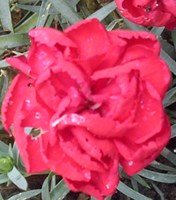
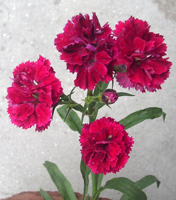
Just like roses, the carnation is found in many shades of red, as well as some other boutique colors. The most common color found at flower shops is pink, which is the traditional flower worn by mothers on Mother's Day in North America. According to Christian mythology, carnations sprang forth from the ground where Mary's tears fell to the earth as Jesus carried the cross to Golgotha. The pink carnation, therefore, has come to symbolize the undying love a mother has for her child.
White, of course, symbolizes purity as well as luck. Red sends a message of love. A light color red is more admiration, but a deep red sends the message of more intimate feelings of affection.
Green carnations are typically worn in Ireland on St. Patrick's Day (March 17th). Oscar Wilde famously wore one all the time, and it has since become an enduring symbol of homosexuality.
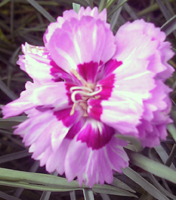
Though it is not quite clear why, a yellow carnation has come to mean disappointment or dejection, and the more rare striped or two tone carnations are traditional signs of regret or refusal. While two toned carnations are grown in those colors, they are a variety that have been more or less created by selective cultivation over the past century or so by very talented and bright florists.
Because of the increasing cleverness of modern flower growers, the carnation has adopted as natural colors just about anything under the sun. Flower dying techniques have allowed an almost limitless range of colors, but they are also grown with naturally bi color petals, in solid purple, green, yellow, and cream. You can even find them in several different configurations, including many small heads on one stem, commonly referred to as the 'spray' variety.
No matter what the different colors signify, the carnation has come to be one of the most popular flowers for countless occasions. They are simply captivating with their rumpled allure, and mysterious charm. Its natural longevity, strong stem and situational versatility make this flower sure to be a favorite for years to come.
Carnations have been cultivated for thousands of years, starting with, or even predating the Greeks. Scientists believe the Dianthus Caryophyllus plant to have originated in the Mediterranean region, though over the last 2,000 years, it has been heavily grown to the point that it has no real region or homeland. It grows anywhere in moderate temperatures with full sunlight and well drained soil.
The Normans introduced the plant to the British Isles as far back as 1100 A.D., and since then, British horticulturists have been experimenting with new colors, breeds, and sizes. Unfortunately, the original varieties of carnation plant that were brought by the Normans were very highly prized for their strong scent, which the flowers slowly lost as they bred larger and more colorful buds. Some of the more richly scented varieties are still available, but you almost have to know someone to find one of these oldest lines of carnation.
The carnation plant has been imported to countries all over the globe and each has made it its own. Australia, for instance, introduced the flower in the mid 20th century as an exotic plant, but domestic cultivation has been going strong since then and will continue for the foreseeable future.